SOTO WindMaster 4-Flex Stove
- Matt Adams
- Sep 19, 2025
- 3 min read


Overview
The SOTO WindMaster 4-Flex is a high-performance canister gas stove designed for backpacking and general outdoors use, with a particular emphasis on wind resistance, simmer control, and versatility. Its features include a micro regulator for more consistent output, a push-button piezo ignition, and interchangeable pot supports (4-Flex included, Tri-Flex optional) for accommodating different pot sizes. The WindMaster is built with a recessed burner head and low pot stand that help protect the flame from the wind, making it more efficient in challenging conditions compared to many upright canister stoves.
Strengths
Excellent Wind Resistance Thanks to a recessed burner head, close pot support, and overall design, the WindMaster holds up well in gusty or exposed conditions. It doesn’t require as much additional wind protection as many comparable stoves.
High Power Output With a maximum output of around 11,000 BTU (≈ 3260 W), it boils water quickly. Boil times are very good during testing: approximately 4 minutes or less for 1 L under moderate conditions.
Micro Regulator for Consistency The built-in regulator helps maintain gas output as canister pressure drops (due to cold, partial depletion). So performance is more stable in cold weather and as fuel runs low.
Versatile Pot Support System (4-Flex / Tri-Flex) The included 4-Flex support provides stability for larger pots and group cooking. If you want to save weight or use smaller pots, the Tri-Flex option gives you that flexibility.
Ignition and Flame ControlThe push-button piezo ignition is usually reliable. Flame control is smooth (thanks to the micro regulator), allowing decent simmering or controlled low flame cooking.
Build QualityReviewers praise its solid construction, finish, and durability over long field use. It handles rough conditions well.
Weaknesses
Weight & Bulk Compared to Minimalist Stoves With the 4-Flex support attached, the stove is heavier and bulkier than very minimal backpacking stoves. If your priority is absolute minimum weight / pack size, there are lighter options.
Price It is more expensive than many “barebones” canister stoves. You're paying for its advanced features—regulator, windproofing, pot supports, etc.
Pot Support Removability / Complexity The detachable pot support (4-Flex) adds versatility but also adds points of failure/loss. Some users find installing/removing it in the field fiddly. If lost, one is left with minimal support (or must carry spares).
Lower Output Under Wind / Cold (Still Affected) Though it's much better than many, the stove’s performance still degrades under strong wind and cold, especially at partial canister pressures. The regulator helps, but physics still apply.
Flimsy Carry Bag / Accessories Some users mention that the stove’s bag is lightweight / flimsy considering the price. Also, some parts are small or thin, which might be more vulnerable to damage or loss.
Product Details
Specification | Detail |
Fuel Type | Canister gas (Isobutane / Propane mix) |
Ignition | Integrated push-button piezo |
Regulator | Micro-regulator for more consistent output under variable conditions |
Maximum Output | ~ 11,000 BTU (≈ 3260 W) |
Boil Time (1 L water, moderate conditions) | ~ 4 minutes (≈ 4:02) with 4-Flex support |
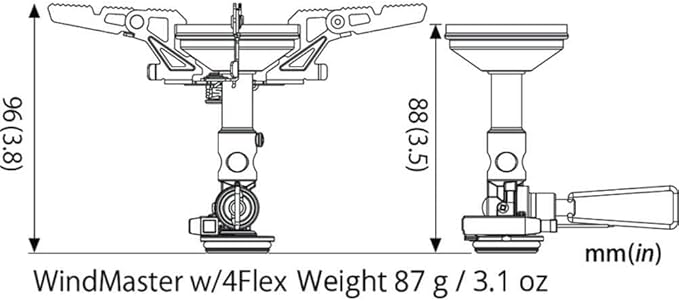
Weight (with 4-Flex support) | ~ 87 grams |
Weight (without 4-Flex / using Tri-Flex) | Lighter – savings by removing or swapping support arms (exact ~20-30 g less) |
Pot Support Options | 4-Flex (included) for larger / group pots; optional Tri-Flex for lighter / solo use |
Pot Support Width (4-Flex) | ~142 mm (≈ 5.6 in) across support arms |
Dimensions (Packed / In-Use) | Packs down compactly when supports folded or removed; larger footprint when in use. Specific dimensions vary with support attached. |
Best Use Cases | Windy conditions; cold weather; cooking for 1–2 people; mixed terrain where wind protection matters |
Typical Limitations | Bulk (with support), relative cost, accessory vulnerability, still affected by cold/wind (though much less so than many rivals) |